

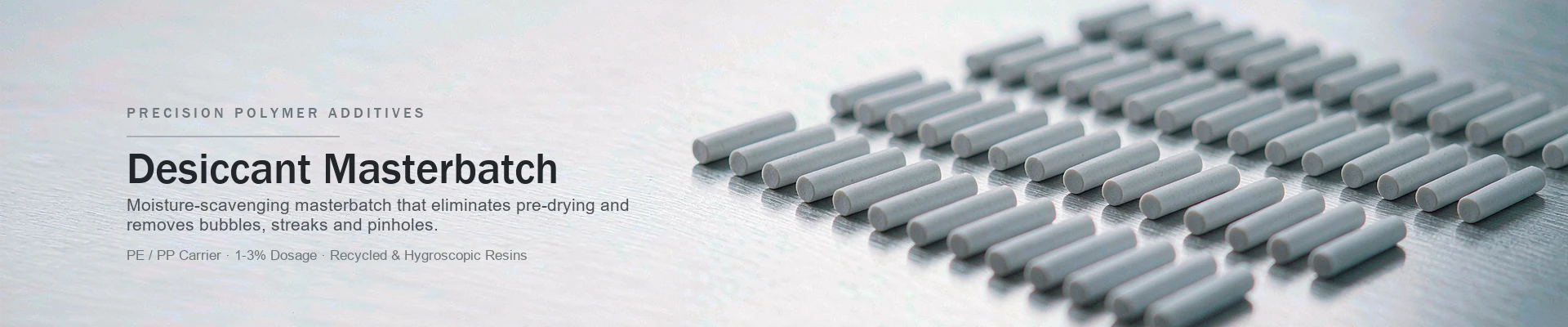
Desiccant Masterbatch
Desiccant Masterbatch Manufacturer for Recycled PE and PP Processing
XINYU manufactures Desiccant Masterbatch for selected recycled PE and PP processing routes where manageable residual moisture contributes to bubbles, pinholes, silver streaks, voids, porosity or unstable conversion. The range includes film-grade, blow-molding, injection-molding and broader anti-moisture directions so the product can be matched to the stage where the defect appears.
A visible bubble or surface mark does not prove that water is the only cause. Contamination, mixed polymer, trapped air, poor venting, thermal degradation, excessive residence time, head or die deposits and unstable feedstock can create similar symptoms. XINYU therefore treats Desiccant Masterbatch as one part of a moisture-control and defect-diagnosis process, not as a universal correction for every recycled-plastic problem.
-
![Film Grade Desiccant Masterbatch]() Film Grade Desiccant MasterbatchResidual water and volatile carryover can interrupt a blown-film line long before the problem is visible in the finished roll. Film Grade Desiccant Masterbatch supports selected recycled-film...read more
Film Grade Desiccant MasterbatchResidual water and volatile carryover can interrupt a blown-film line long before the problem is visible in the finished roll. Film Grade Desiccant Masterbatch supports selected recycled-film...read more -
![Desiccant Masterbatch for Blow Molding]() Desiccant Masterbatch for Blow MoldingA hollow product can look acceptable at the mold and still fail at the pinch-off, handle, neck or thinnest wall. Desiccant Masterbatch for Blow Molding supports selected recycled blow-molding...read more
Desiccant Masterbatch for Blow MoldingA hollow product can look acceptable at the mold and still fail at the pinch-off, handle, neck or thinnest wall. Desiccant Masterbatch for Blow Molding supports selected recycled blow-molding...read more -
![Desiccant Masterbatch for Injection Molding]() Desiccant Masterbatch for Injection MoldingSilver streaks, splay and internal voids can interrupt injection molding, but the visible mark does not identify the cause by itself. Desiccant Masterbatch for Injection Molding supports...read more
Desiccant Masterbatch for Injection MoldingSilver streaks, splay and internal voids can interrupt injection molding, but the visible mark does not identify the cause by itself. Desiccant Masterbatch for Injection Molding supports...read more -
![Anti Moisture Masterbatch]() Anti Moisture MasterbatchMoisture-related defects often begin upstream, during washing, mechanical drying, storage, agglomeration or recycled-pellet production. Anti Moisture Masterbatch provides a structured...read more
Anti Moisture MasterbatchMoisture-related defects often begin upstream, during washing, mechanical drying, storage, agglomeration or recycled-pellet production. Anti Moisture Masterbatch provides a structured...read more


DESICCANT MASTERBATCH PRODUCT DIRECTIONS
The XINYU Desiccant Masterbatch range is divided by conversion route. This allows the trial to follow the actual material path, equipment and finished-product defect.
Film Grade Desiccant Masterbatch
For selected recycled PE blown film, garbage-bag film, non-food flexible film and film-pelletizing routes affected by manageable residual moisture. The trial checks feeding, pressure, screen condition, bubble behavior, pinholes, surface, strength and sealing.
01
Desiccant Masterbatch for Blow Molding
For selected recycled PE or PP hollow products and industrial containers where moisture-related gas may contribute to bubbles, voids or roughness. Parison behavior, wall distribution, pinch-off, surface, leakage and container integrity remain approval points.
02
Desiccant Masterbatch for Injection Molding
For selected recycled PE and PP molded parts where manageable moisture is confirmed as part of silver streaks, splay, gas marks or internal voids. Venting, plasticization, residence time, packing and degradation must also be reviewed.
03
Anti Moisture Masterbatch
For broader recycled PE and PP pelletizing, extrusion, film and injection routes where moisture enters through washing, mechanical drying, storage, agglomeration or recycled-pellet handling. It supports moisture control while odor, contamination, mixed polymer and degradation remain separate technical issues.
04
WHAT DESICCANT MASTERBATCH HELPS PROCESSORS CONTROL
A suitable Desiccant Masterbatch can support selected recycling and conversion lines when residual water is within a manageable range and the rest of the material and process system is under control.
- Moisture-related gas reduction: The appropriate grade direction can help reduce defects associated with manageable residual moisture in selected PE and PP processing.
- Application-specific carrier and process direction: Film, blow molding, injection molding and pelletizing place different demands on flow, pressure, mixing, venting and finished-product performance.
- More stable recycled-material conversion: When water is a confirmed contributor, moisture control can support steadier extrusion or molding and reduce moisture-related interruption.
- Defect diagnosis before product selection: XINYU reviews the defect location and timing so that water is separated from contamination, trapped air, degradation and equipment effects.
- Controlled trial and observation: The product is evaluated through material preparation, line signals, defect frequency and finished-product performance rather than appearance alone.
- Protected supply and handling: Moisture-control masterbatch is packed and handled with attention to moisture exposure, and partly used bags should be resealed promptly.
IDENTIFY WHERE MOISTURE ENTERS THE PROCESS
Before choosing a Desiccant Masterbatch, map the route by which the recycled material is washed, dried, stored, conveyed, compounded and converted. This reveals whether the main improvement should come from drying, storage, venting, filtration, material sorting, formulation or the masterbatch trial.
Recycled film
Check washed or pelletized PE, storage exposure, dosing, extrusion pressure, screen residue, bubble behavior, pinholes, surface, film breaks, strength and sealing. Volatile contamination or degradation should not be mistaken for moisture.
Recycled blow molding
Check material drying and storage, head and die condition, parison appearance, bubbles, voids, wall distribution, pinch-off, leakage and drop behavior. Trapped air, head deposits and excessive parison stretch can create similar defects.
Recycled injection molding
Check resin and regrind preparation, hopper and dryer condition, feed, plasticization, venting, residence time, back pressure, silver streaks, gas marks, voids, short shots, surface and part performance.
Recycled pelletizing and extrusion
Check washing, mechanical dewatering, thermal drying, agglomeration, storage, feeding, venting, vacuum, filtration, pellet porosity and downstream conversion. Porous pellets can carry moisture and air into the next process.
Storage and material handling
Open bags, humid storage, condensation, wet conveying lines and delayed use after drying can reintroduce moisture. Control the material path before increasing additive use.
MATERIAL, EQUIPMENT AND PROCESS CHECKPOINTS
Desiccant Masterbatch performance depends on where and how it is introduced. The review follows the material from incoming recycled feedstock to the final defect and includes the line conditions that can create gas or prevent it from escaping.
Feedstock Identity And Preparation
Document polymer mix, source, washing, dewatering, drying, storage time, agglomeration or pelletizing and known contamination.
Moisture Exposure After Drying
Review silos, bags, floor storage, conveying lines, hoppers and production waiting time because dry material can absorb or collect moisture again.
Dosing And Mixing
The Desiccant Masterbatch must be weighed and distributed consistently. Segregation or dose variation can produce an uneven result.
Plasticization And Residence Time
Temperature profile, screw speed, back pressure, motor load and residence time influence melting, dispersion and degradation.
Venting, Vacuum And Filtration
Blocked vents, weak vacuum, unsuitable filtration or rapid pressure rise can retain gas or indicate contamination that a moisture-control additive cannot correct.
Defect Position And Timing
Record whether the defect begins in the pellet, melt, die, bubble, parison, mold filling, cooling or finished product. The stage helps identify the likely cause.
HOW TO RUN A MOISTURE-CONTROL TRIAL
A useful Desiccant Masterbatch trial starts with a stable feedstock reference and records both moisture-related defects and other process signals. The goal is to confirm whether the selected grade improves the actual production problem without creating a new filtration, surface or performance issue.
- Provide the polymer mix, recycled source, washing and drying route, storage condition, current formula and defect history.
- Describe the extruder or molding machine, screw, venting or vacuum, filtration, die, head or mold and downstream operation.
- Record feed condition, dosing, motor load, pressure, output, vent behavior, screen residue, deposits, odor and the location and frequency of defects.
- Compare the finished film, pellet, container or molded part for surface, porosity, pinholes, bubbles, voids, strength, sealing, leakage, dimensions or other release properties.
- If the defect remains, review drying, contamination, mixed polymer, degradation, venting and equipment condition before changing the grade or formula.
Responsible Use
Desiccant Masterbatch supports selected conditions with manageable residual moisture. It does not replace effective drying of severely wet material and does not correct contamination, mixed polymer, oxidation, thermal degradation or mechanical equipment problems.
HOW XINYU PROTECTS DESICCANT MASTERBATCH QUALITY
XINYU controls Desiccant Masterbatch through material release, recorded production, finished-batch inspection, equipment management, moisture-protective packaging and batch traceability. The customer receives a defined grade and batch reference for receiving inspection and follow-up.
Incoming material inspection
Applicable carrier materials, active moisture-control components, processing aids and moisture-protective packaging are checked before use.
Recorded production control
Defined controls are recorded during weighing, mixing, compounding, pelletizing, cooling and sealed packing.
Finished-batch inspection
Each lot is inspected against the release requirements established for the selected film, blow-molding, injection or anti-moisture grade.
Production equipment management
Mixing, extrusion, pelletizing, cooling and packing equipment is maintained and verified for production readiness.
Inspection equipment management
Balances and applicable moisture and functional inspection devices are calibrated or verified on controlled schedules.
Packaging and traceability
Sealed packaging and batch identification connect the product with incoming, production, inspection, packaging and shipment records.
FREQUENTLY ASKED QUESTIONS
Q1. What is Desiccant Masterbatch used for?
It is used in selected PE and PP recycling and conversion routes to help control defects associated with manageable residual moisture, including certain bubbles, pinholes, silver streaks, voids and porous pellets.
Q2. How do I know whether a defect is caused by moisture?
Review the feedstock preparation, storage, venting, filtration, defect position, odor, deposits and thermal history. A controlled comparison helps separate moisture from trapped air, contamination and degradation.
Q3. Can Desiccant Masterbatch replace material drying?
It is not a substitute for effective drying when material is severely wet. Washing, dewatering, thermal drying, storage and conveying should be controlled first.
Q4. Which grade should be used for blown film?
Film Grade Desiccant Masterbatch is the relevant starting direction for selected recycled film. The PE blend, moisture route, screen behavior, bubble, pinholes, strength and sealing must still be evaluated.
Q5. Can it be used in blow molding and injection molding?
Dedicated grade directions can be evaluated for selected recycled hollow products and molded parts. The trial must separate moisture from venting, residence time, head, die, mold and packing effects.
Q6. What data should be recorded during the trial?
Record material preparation, dosing, temperature, motor load, pressure, output, venting, screen residue, deposits, defect frequency and the relevant finished-product tests.
Q7. How should opened bags be handled?
Keep the product dry, close partly used bags promptly and prevent exposure to water, condensation and humid storage. Follow the packaging and storage information supplied for the selected grade.
Q8. What documents can XINYU provide?
Product information, SDS and agreed delivery documents can be provided for the specific supplied grade according to the customer and order requirement.
Map the Moisture Path with XINYU
Share your recycled polymer, washing and drying route, storage, formula, equipment, defect, process observations and finished-product requirements. XINYU will identify the relevant Desiccant Masterbatch direction and the information needed for a controlled trial.
Jiande Xinyu Plastic Materials Co., Ltd. is one of the most professional desiccant masterbatch manufacturers and suppliers in China. With abundant experience, we warmly welcome you to wholesale bulk high quality desiccant masterbatch from our factory. If you have any enquiry about custom service, please feel free to email us.