

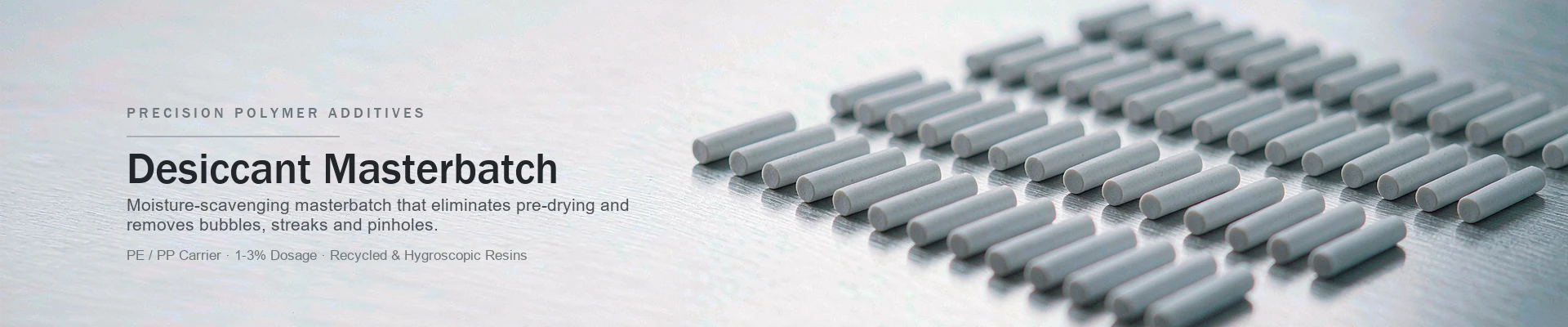

Jiande Xinyu Plastic Materials Co., Ltd. is one of the leading manufacturers and suppliers of anti moisture masterbatch in China. We have world-leading production equipment and strong manufacturing capabilities. Welcome to wholesale bulk custom made anti moisture masterbatch from our factory.
PRODUCT AND APPLICATIONS
Product Overview
Anti Moisture Masterbatch is a pelletized moisture-control masterbatch used in selected polyolefin recycling and conversion trials. Its role is to support the management of limited residual water during melting; it is not a drying machine, filtration device, deodorization system or polymer restorer.
A useful application begins with the recycling route. Washed flake may retain surface or internal water, agglomerate can trap air, printed scrap can carry volatiles, and mixed polymer can degrade or separate during extrusion. This product family should be introduced only after these inputs and the location of gas formation are understood.
Moisture Absorber Masterbatch and Moisture Absorbent Masterbatch grades are selected around the actual recycling route. PE or PP compatibility, feedstock condition, extruder venting, filtration, pellet quality and the intended downstream process determine which moisture-control direction is suitable.
What the Recycler Needs to Distinguish
Residual water | Entrained air | Organic volatiles | Ink and adhesive | Mixed polymer | Thermal degradation | Filtration load | Downstream product performance
Select the Grade Direction Around the Moisture Path
Anti Moisture Masterbatch covers several grade directions within recycled PE and PP pelletizing with downstream moisture control. The water path from washing through venting, pellet storage and conversion determines the relevant grade direction.
|
Grade Direction |
Typical Production Focus |
Main Balance to Confirm |
|
Recycled pelletizing |
PE or PP recycling lines with water carried from washing, dewatering or storage. |
Feed condition, vent loading, screen pressure, pellet structure and packaging. |
|
Downstream film |
Recycled pellets used in film with bubbles, pinholes or unstable extrusion. |
Pellet storage, filtration, bubble behavior, gauge, strength and sealing. |
|
Downstream injection |
Recycled pellets used in molded parts with streaks, gas marks or voids. |
Shot preparation, venting, part section, dimensions and mechanical checks. |
|
General recycled extrusion |
Profiles or sheet made from a controlled recycled material stream. |
Moisture path, pressure trend, surface, dimensions and accepted output. |
Recycling Problems This Product Helps the Processor Investigate
Anti Moisture Masterbatch is selected around the production result that the customer must control. This product family is relevant when residual water remains one identifiable contributor. Recycling defects usually have several inputs, so water, gas, contamination and thermal history should be recorded separately.
- Porous or foamed pellets: Water, entrained air, volatile residues, weak vacuum or a hot underwater cutting condition can create internal or surface voids.
- Gas at the die: Residual water, printing residues, oil, detergent, adhesive and degradation products may all evolve during melting.
- Unstable vacuum vent: Feed surging, melt flooding, blocked condensate lines and excessive volatile load reduce degassing efficiency.
- Rapid screen loading: Paper, aluminum, wood, dirt, gels and incompatible polymer remain filtration problems, not moisture problems.
- Odor after pelletizing: Organic contamination and degradation can persist even if visible bubbles decrease.
- Downstream defects return: Pellets can regain moisture during cooling, open storage, transport or humid hopper exposure.
Benefits for Recycled-Plastic Processors
Anti Moisture Masterbatch supports a defined application and performance range when the grade, formula and line are coordinated. Its value is measured through controllable pellet production and fewer water-related defects in the intended downstream process.
- Upstream process focus: Examines washing, dewatering, mechanical drying, storage and agglomeration before material reaches the extruder.
- Cross-process diagnosis: Helps separate water-related porosity from odor, oil, ink, paper, metal, incompatible resin and degraded polymer.
- Pelletized moisture-control delivery: Supports cleaner and more consistent feeding through selected PE or PP-compatible carrier systems.
- Venting and filtration alignment: Includes atmospheric vent, vacuum stability, screen loading, pressure and pellet-cut behavior in the evaluation.
- Downstream confirmation: Extends the trial into film, injection, extrusion or blow molding so pellet appearance does not become the only decision.
- Lot-to-lot visibility: Links feedstock source and storage with process trends and accepted-output records.
- Practical production economics: Reviews drying demand, output, energy where measured, screen use, pellet rejects and downstream acceptance together.
Product Performance Priorities
The practical value of the selected grade is confirmed in recycled pellets and the film, molded part, sheet or profile made from them. The priorities below connect pellet condition with the production result that ultimately determines acceptance.
- Incoming feedstock: Defines the starting condition and lot variation.
- Feeding: Shows whether trapped air or unstable mass flow enters the extruder.
- Degassing: Shows whether gas-removal equipment is operating effectively.
- Filtration: Separates dirt and gels from water-related gas.
- Pellet quality: Shows the immediate product of the recycling line.
- Pellet consistency: Supports lot comparison under stated conditions.
- Downstream conversion: Confirms whether the pellet performs in its intended process.
- Accepted economics: Shows the total production value of the change.
Applications
Anti Moisture Masterbatch is positioned for the application categories below. The supplied grade is selected from polymer stream, washing and dewatering, venting, filtration, pellet handling, storage and downstream conversion.
- RECYCLED PE AND PP PELLETIZING
- RECYCLED FILM
- RECYCLED INJECTION MOLDING
- RECYCLED EXTRUSION
- MOISTURE-RELATED BUBBLE AND VOID CONTROL
FORMULATION AND PROCESSING
How Moisture Enters and Leaves a Recycling Process
Anti Moisture Masterbatch works at one point in a broader material-treatment chain. The recycling route should remove as much free water and contamination as practical before melt processing, then prevent re-exposure after pelletizing.
|
Process Input |
Possible Effect |
Control Direction |
|
Washed flake |
Carries surface water and can retain water in labels, folds and porous material. |
Control wash separation, dewatering, mechanical drying and residence. |
|
Film agglomerate |
Irregular bulk density traps air and changes feeder stability. |
Control densification, particle distribution and hopper behavior. |
|
Printed or laminated scrap |
Ink, adhesive and barrier layers can release odor, volatiles or incompatible phases. |
Identify structure and separate unsuitable streams where possible. |
|
Moisture-control pellets |
Provide limited in-melt support for residual water. |
Match carrier, dose accurately, protect from ambient exposure and verify response. |
|
Vent and vacuum system |
Removes gas and volatile material when melt does not flood the opening. |
Trend vacuum, condensate, vent appearance and maintenance condition. |
|
Screen and filter |
Removes solid contamination and gels according to the filtration design. |
Record pressure, screen life and residue classification. |
|
Pellet cooling and storage |
Water contact, hot packing or open storage can change pellet condition again. |
Control cooling, surface drying, bagging temperature and package sealing. |
This product family selection requires a material and process map. A single water reading without the sample point, time and handling condition cannot explain the whole recycling line.
Where Recycled-Material Condition Is Controlled
Anti Moisture Masterbatch should be evaluated with the actual preparation and pelletizing equipment. A moisture-control material cannot compensate for a flooded vent, damaged vacuum system, unstable feeder or overloaded filter.
- Washing and separation: Wash temperature, friction, rinsing and density separation influence residual dirt, detergent and mixed polymer.
- Dewatering and mechanical drying: Centrifugal or mechanical water removal reduces the burden carried into thermal or melt treatment.
- Densifier, compactor or agglomerator: Temperature, residence and bulk-density control affect trapped air, feeding and material heat history.
- Feeding system: Force feeder, side feeder or hopper design must deliver low-bulk-density material and pellets without surging.
- Extruder and melt zones: Screw configuration, load, temperature and residence determine mixing, evaporation and degradation risk.
- Atmospheric and vacuum degassing: Vent opening, melt seal, vacuum level, condenser and pump condition determine gas-removal performance.
- Screen changer and melt pump: Pressure before and after filtration and stable melt delivery show contamination load and process continuity.
- Pelletizer and cooling: Strand, water-ring or underwater cutting and subsequent drying influence pellet porosity, temperature and surface water.
- Silo and packaging: Cooling time, condensation, bag sealing and warehouse humidity protect the finished pellets before downstream use.
Recycling-Line Signals to Record
|
Decision Gate |
Evidence to Review |
Required Conclusion |
|
Cause classification |
Water, air, volatile, contamination, mixed resin and degradation evidence |
Is moisture a meaningful part of the problem? |
|
Preparation route |
Washing, dewatering, drying, densifying and exposure |
Has practical upstream water removal been applied? |
|
Melt processing |
Feed, load, vent, vacuum, pressure, screen and output |
Can the line handle the material consistently? |
Common Anti-Moisture Trial Issues and First Checks
Review Anti Moisture Masterbatch at the stage where the symptom first becomes measurable. When a result is incomplete, the remaining defect often points to another part of the recycling system. The first check should identify which evidence layer changed and which did not.
- Pellet porosity improves, odor remains: Water contribution reduced while organic contamination or degradation remains. Check: Review feedstock source, wash chemistry, vent condensate and thermal history.
- Vacuum remains unstable: Vent flooding, feed surging, blocked condenser or excessive volatile load. Check: Inspect vent opening, melt seal, vacuum trend and condensate route.
- Pressure still rises quickly: Solid contamination, gels, mixed resin or inadequate filtration area. Check: Classify screen residue and compare pressure positions and throughput.
TRIAL, TESTING AND GRADE APPROVAL
How to Select and Approve the Moisture-Control Grade
Evaluation of Anti Moisture Masterbatch begins with root-cause classification and follows one identified lot through pelletizing and downstream conversion. This prevents an improvement at the die from hiding an unresolved odor, contamination or mechanical problem.
Information You Provide
- Map the feedstock source, wash and drying route, storage, water sampling, contamination, odor, feeding, extruder, vents, filtration, pelletizer and intended downstream use.
- Provide the water-entry map, dewatering and vent records, screen history, pellet observations, storage time and downstream defect record.
- Define the acceptable pellet structure, process stability, defect reduction, mechanical retention and total economics for the selected route.
What We Assess and Recommend
- We map the water path from washing and dewatering through venting, pellet storage and downstream conversion.
- We match the moisture-control direction to polymer family, material condition, extrusion system and final process.
- We review pellet and downstream evidence together before recommending routine use.
What You Confirm on Your Line
- Record baseline water context, feed stability, load, temperature, vacuum, pressure, screen residue, pellet porosity, odor and downstream defects.
- Introduce the selected anti-moisture material through calibrated dosing while keeping source lot, throughput, vent, filtration and pellet-cooling conditions controlled.
- Approve only when repeated lots show stable pelletizing, identified residual risks and acceptable downstream film, molding, extrusion or blow-molding performance.
Downstream Product Checks
- Incoming feedstock: Water result, bulk density, odor, contamination and storage exposure. Defines the starting condition and lot variation.
- Feeding: Rate, surging, bridging, motor load and compactor behavior. Shows whether trapped air or unstable mass flow enters the extruder.
- Degassing: Vent appearance, vacuum trend, condensate and melt flooding. Shows whether gas-removal equipment is operating effectively.
- Filtration: Pressure trend, screen life and classified residue. Separates dirt and gels from water-related gas.
HOW WE CONTROL PRODUCT QUALITY
We control Anti Moisture Masterbatch through incoming inspection, production records, finished-batch release, equipment management and batch traceability. These controls support incoming inspection of the moisture-control and any later quality follow-up.
- Incoming material inspection: We inspect and release applicable carrier materials, active moisture-control components, processing aids and moisture-protective packaging before use.
- In-process control: We record key controls during incoming release, weighing, compounding, pelletizing, cooling and sealed packing.
- Finished batch inspection: We release each batch against grade-specific checks for pellet consistency, flow, defined functional indicators and packaging integrity, as applicable.
- Production equipment management: We maintain mixing, extrusion, pelletizing, cooling and packing equipment and verify its operating condition.
- Inspection equipment management: We calibrate or verify balances and other functional inspection devices on controlled schedules.
- Batch identification and traceability: We link each moisture-control batch with incoming materials, production, inspection, packaging and shipment records.
STORAGE, RESPONSIBLE USE AND FAQ
Handling And Storage
Prevent Re-Exposure Before Processing
Keep original bags sealed, dry, intact and clearly identified. Limit open-bag time, reseal partial bags promptly and avoid humid hopper residence. Finished recycled pellets should also be cooled, dried and packed under conditions that prevent condensation or renewed moisture uptake.
Responsible Use
Moisture-Control Boundary
Use only after the recycling and downstream trial confirms suitability. This product has limited moisture-control capacity and does not remove odor, solid contamination, mixed polymer or degradation. Severe moisture requires effective upstream water removal.
Product FAQ
Q1. What information is needed to evaluate this product family?
Provide polymer and feedstock source, print or laminate structure, washing and drying route, water sampling details, feeding, extruder and vent design, filtration, pelletizer, current defects and downstream application.
Q2. Is Moisture Absorber Masterbatch the same as a drying system?
No. It is a pelletized in-process moisture-control direction with limited capacity. Dewatering and drying remove water upstream and remain central to recycled-material preparation.
Q3. What does Moisture Absorbent Masterbatch not remove?
It does not filter paper or metal, separate incompatible polymers, eliminate all organic odor or restore polymer damaged by excessive heat and oxidation.
Q4. Why should vent condensate and screen residue be inspected?
Vent condensate helps identify released water or organics, while screen residue shows the solid contamination and gels that moisture control cannot remove.
Q5. Can a pellet look dense but still fail in film or molding?
Yes. Volatiles, contamination, re-exposure, mixed resin and mechanical-property variation may only become evident in the downstream process.
Q6. How should a Moisture Absorber Masterbatch trial be compared?
Use an identified feedstock lot and controlled throughput, venting, filtration and pellet cooling, then compare both pellet evidence and downstream acceptance.
Q7. Can Moisture Absorbent Masterbatch be used for PE and PP?
Selected PE and PP grades can be discussed, but carrier compatibility, process temperature, recycled source and downstream use determine the actual product selection.
Q8. Why can the response change after storage?
Open packaging, warm pellet bagging, condensation, humid silos and long hopper exposure can change material condition again before conversion.
Map the Moisture Path in Your Recycling Process
Share the polymer stream, washing and dewatering route, venting, filtration, pellet storage, downstream process and defect record. We will use this map to define a controlled moisture-control trial.
Hot Tags: anti moisture masterbatch, China anti moisture masterbatch manufacturers, suppliers, factory