

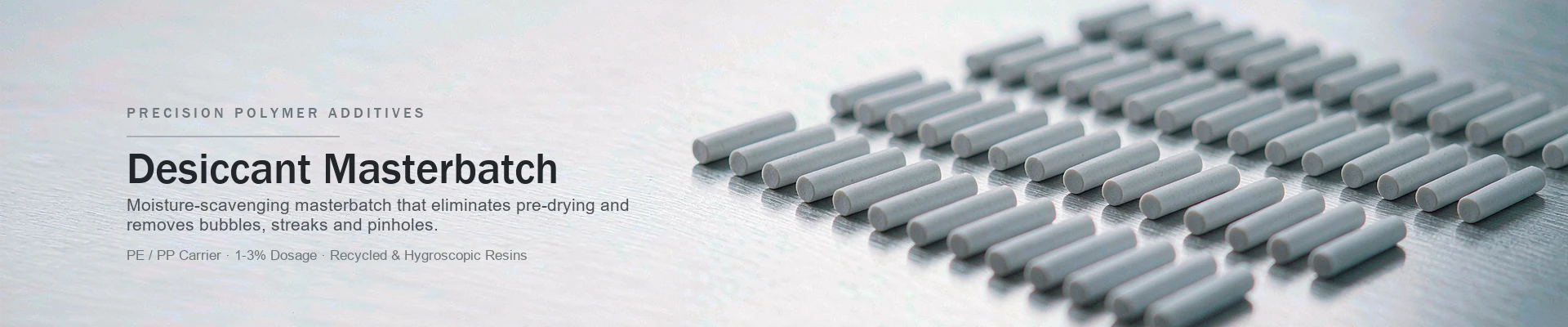

Jiande Xinyu Plastic Materials Co., Ltd. is one of the leading manufacturers and suppliers of film grade desiccant masterbatch in China. We have world-leading production equipment and strong manufacturing capabilities. Welcome to wholesale bulk custom made film grade desiccant masterbatch from our factory.
PRODUCT AND APPLICATIONS
Product Overview
Film Grade Desiccant Masterbatch is a moisture-control masterbatch direction for selected PE and PP film processing, with particular relevance to recycled polyolefin streams. In a suitable formulation, the moisture-control phase is dispersed through a compatible carrier so that limited residual water can be managed during melt processing. The result must be judged on the actual extruder, screen pack, annular die and film specification.
Bubbles and pinholes are not automatically moisture defects. Entrained air, printed-film residues, oils, incompatible polymers, degraded material, excessive melt temperature, poor venting and die deposits can create similar symptoms. A useful trial therefore records material history and process behavior before deciding whether this product family is the correct response.
Blown Film Desiccant Masterbatch is selected for the actual film route and defect pattern. A Pe Film Desiccant Masterbatch or other Desiccant Masterbatches For Moisture Control grade is matched to the polymer family, recycled ratio, measured material condition, film thickness, line filtration and the finished-film properties that must be retained.
What the Film Producer Needs to Control
Residual moisture | Melt cleanliness | Filter-pressure trend | Bubble and frost-line stability | Pinholes and gels | Gauge profile | Sealing and mechanical acceptance
Select the Grade Direction Around the Film Defect
Film Grade Desiccant Masterbatch covers several grade directions within recycled PE blown film with diagnosed water-related defects. Water condition, recycled ratio, film gauge, filtration and defect location determine the relevant desiccant direction.
|
Grade Direction |
Typical Production Focus |
Main Balance to Confirm |
|
General recycled film |
Recycled PE film where manageable water contributes to bubbles or pinholes. |
Material condition, venting, pressure, gauge and accepted film yield. |
|
Lower-defect film direction |
Film that is more sensitive to local weak points, specks or winding defects. |
Water diagnosis, contamination, filtration, dispersion and surface inspection. |
|
High-recycled-content film |
Selected film formulas with a larger but controlled recycled-PE contribution. |
Batch variation, mixed polymers, odor, mechanical retention and sealing. |
|
Pellet-to-film program |
Recycled pelletizing and blown-film conversion evaluated as one material route. |
Dewatering, venting, pellet storage, film processing and defect recurrence. |
Film Defects This Product Helps the Producer Investigate
Film Grade Desiccant Masterbatch is selected around the production result that the customer must control. This product family is most useful when the defect pattern points to a manageable moisture contribution. The location, timing and appearance of each defect help distinguish water-related gas from other causes.
- Fine bubbles in the melt or film: Residual water can form gas during melting, but volatile residues and polymer degradation may produce a similar appearance.
- Pinholes and weak spots: A gas pocket, contaminant, gel, coarse particle or local thin area can rupture during bubble expansion or bag conversion.
- Unstable frost line: Changing feed condition, melt temperature, output, cooling air and blow-up ratio can move the frost line and disturb gauge control.
- Rising filter pressure: Paper, aluminum, dirt, cross-polymer contamination and agglomerates load the screen; a moisture-control additive does not remove them.
- Rough or streaked surface: Die deposits, poor dispersion, oxidation, print residue and moisture-related gas should be checked separately.
- Seal or strength loss: Film thickness, resin blend, orientation, contamination and total additive balance determine whether converted bags remain acceptable.
Benefits for Recycled Film Producers
Film Grade Desiccant Masterbatch supports a defined application and performance range when the grade, formula and line are coordinated. Its value is measured through fewer moisture-related defects while bubble stability, film mechanics and sealing remain acceptable.
- Film-focused moisture control: Provides a practical route for evaluating manageable water-related gas in selected recycled blown-film formulations.
- Cleaner defect diagnosis: Separates probable moisture symptoms from contamination, thermal degradation, entrained air, incompatible resin and printing residues.
- Controlled pellet dosing: Free-flowing pellets support stable gravimetric or calibrated volumetric feeding and cleaner handling than loose reactive powder.
- Bubble-stability review: Connects material condition with melt pressure, die flow, frost-line movement, layflat stability and winding continuity.
- Film-quality protection: Keeps pinholes, gels, gauge, tensile, tear, impact and heat-seal behavior inside the approval plan.
- Recycled-feedstock compatibility review: Includes washing, mechanical drying, storage, re-pelletizing, odor, print contamination and lot-to-lot variation.
- Accepted-output economics: Evaluates usable film output, screen consumption, edge trim, roll rejection and bag-conversion loss together with formulation cost.
Product Performance Priorities
The practical value of the selected grade is confirmed in accepted film rolls produced from representative recycled material. The priorities below show whether defect reduction is achieved without hiding contamination or sacrificing film performance.
- Material condition: Links incoming feedstock with the trial response.
- Melt pressure: Shows feeding, melting, filtration and die stability.
- Bubble behavior: Shows whether gas release and cooling remain controllable.
- Defect count: Quantifies improvement without combining different defect types.
- Gauge and roll profile: Confirms that stability is maintained across the web.
Applications
Film Grade Desiccant Masterbatch is positioned for the application categories below. The supplied grade is selected from recycled PE source, material condition, film formula, venting, filtration, gauge and required film properties.
- RECYCLED PE BLOWN FILM
- GARBAGE BAG FILM
- GENERAL FLEXIBLE PACKAGING TRIALS
- RECYCLED FILM PELLETIZING
- FILM WITH MOISTURE-RELATED PINHOLES OR BUBBLES
FORMULATION AND PROCESSING
How Moisture Moves Through a Recycled Film Formula
Film Grade Desiccant Masterbatch operates inside a material system that may contain virgin resin, several recycled streams and other concentrates. Moisture control is effective only when each incoming component and its storage history are understood.
|
Formula Element |
Possible Contribution |
Control Point |
|
Virgin PE or PP |
Provides the main melt-strength and film-property base. |
Record grade, MFR direction, blend ratio and storage condition. |
|
Recycled pellets |
May carry residual water, mixed resin, ink, odor, fines and previous thermal history. |
Separate suppliers and lots; record washing, drying and filtration route. |
|
Agglomerate or regrind |
Irregular bulk density can trap air and create unstable feeding. |
Control particle size, dust, bridge formation and dosing consistency. |
|
Film desiccant |
Provides limited in-melt moisture-control capacity through a compatible pelletized system. |
Keep sealed, dose accurately and verify its effect through line and film data. |
|
Filler or color masterbatch |
Changes total concentrate loading, density, dispersion and filter demand. |
Review carrier compatibility, water condition and combined dosage. |
|
Printing and adhesive residue |
Can release volatiles, odor or deposits that resemble moisture defects. |
Identify post-consumer source and compare washed versus unwashed streams. |
|
Process aid or stabilizer |
Influences die surface, thermal stability, slip, blocking and conversion. |
Maintain a controlled baseline when the moisture-control trial is introduced. |
This product family selection begins with the material route and the film defect, not with a generic dosage. Representative sampling is important because the outside of a bulk bag, the hopper and the recycled pellet core may not have the same condition.
Where Moisture-Control Performance Is Created on the Film Line
Film Grade Desiccant Masterbatch should be evaluated across the entire blown-film route. Hopper exposure, screw design, venting, screen condition, die balance and bubble cooling can reinforce or hide the material effect.
- Material storage and conveying: Open bags, damp floors, outdoor storage and long pneumatic routes can reintroduce moisture or segregation before extrusion.
- Blending and dosing: Gravimetric feeding or a calibrated volumetric feeder stabilizes the resin, recycle, filler, color and moisture-control balance.
- Extruder feed and compression zones: Screw wear, feed surging, temperature profile and motor load determine melting, air release and dispersion.
- Atmospheric or vacuum vent: A correctly operating vent can remove gas and volatiles; flooding, blockage or weak vacuum sharply reduces its value.
- Screen changer and pressure measurement: Pressure before and after filtration helps separate screen loading from downstream die restriction.
- Annular die: Die temperature, lip condition, deposits and flow balance influence surface lines, gauge and bubble symmetry.
- Air ring, cage and take-off: Cooling-air balance, blow-up ratio, frost-line height, haul-off and collapsing geometry determine bubble stability.
- Winder and bag-conversion equipment: Roll tension, blocking, seal response and cutting reveal defects that may not be obvious at the die.
Moisture and Film Signals to Record
|
Trial Stage |
Evidence to Capture |
Approval Question |
|
Incoming material |
Lot, source, water result, odor, pellet condition and exposure |
Is the feedstock representative and adequately characterized? |
|
Melt preparation |
Load, temperature, vent behavior, pressure and screen trend |
Is gas controlled without creating a filtration or thermal problem? |
|
Bubble formation |
Frost line, layflat, wrinkles, width and operator adjustments |
Can the line hold the intended operating window? |
Common Film Moisture-Control Issues and First Checks
Review Film Grade Desiccant Masterbatch at the stage where the symptom first becomes measurable. A disciplined first check prevents the wrong corrective action. Moisture-control performance should be reviewed together with the defect type and where it first appears in the process.
- Bubbles remain unchanged: Non-water volatiles, inadequate contact, severe moisture, poor dosing or blocked vent. Check: Compare water result, odor, vent behavior and pellet distribution.
- Pinholes decrease but gels remain: Moisture contribution improved while contamination or degraded polymer remains. Check: Classify defects under magnification and inspect screen residue.
- Pressure rises after introduction: Agglomerates, mixed material, cold zones, screen loading or excessive total concentrate. Check: Review pressure position, screen residue, temperatures and feeder calibration.
TRIAL, TESTING AND GRADE APPROVAL
How to Select and Approve the Film-Grade Desiccant
Evaluation of Film Grade Desiccant Masterbatch should begin with one clearly characterized film formulation and enough run time to observe pressure, bubble behavior and roll quality. The comparison is meaningful when resin lots, screen pack, output and film geometry are kept under control.
Information You Provide
- Document the recycled material source, wash and pelletizing route, storage, measured condition, complete formulation, line configuration and current defect pattern.
- Provide the recycled PE route, sampling and water information, film formula, pressure history, defect map and accepted roll reference.
- Define the permitted bubbles and pinholes, gauge profile, mechanical retention, sealing and accepted-roll yield for the trial.
What We Assess and Recommend
- We distinguish water-related defects from volatiles, contamination, mixed polymers and thermal degradation.
- We match the desiccant direction to the recycled PE condition, film gauge, filtration and defect pattern.
- We review film processing, sealing and mechanical retention before recommending routine use.
What You Confirm on Your Line
- Establish a baseline with defect counts, pressure trend, frost-line behavior, gauge profile, screen use, sealing and mechanical results.
- Introduce the selected film moisture-control grade through accurate dosing while recording temperatures, output, pressure, vent condition and visible bubble changes.
- Convert representative rolls into the intended bag or packaging format and compare defects, seals, strength, usable output and storage behavior before routine use.
Finished-Film Checks
- Material condition: Water result, package exposure, pellet appearance and lot record. Links incoming feedstock with the trial response.
- Melt pressure: Continuous trend at stable output and screen configuration. Shows feeding, melting, filtration and die stability.
- Bubble behavior: Frost-line position, width movement, wrinkles and operator interventions. Shows whether gas release and cooling remain controllable.
- Defect count: Defined film area inspected for bubbles, pinholes, gels and black specks. Quantifies improvement without combining different defect types.
HOW WE CONTROL PRODUCT QUALITY
We control Film Grade Desiccant Masterbatch through incoming inspection, production records, finished-batch release, equipment management and batch traceability. These controls support incoming inspection of the film-grade desiccant and any later quality follow-up.
- Incoming material inspection: We inspect and release applicable carrier materials, active moisture-control components, processing aids and moisture-protective packaging before use.
- In-process control: We record key controls during weighing, mixing, extrusion, pelletizing, cooling and sealed packing.
- Finished batch inspection: We release each batch against grade-specific checks for pellet appearance, consistency, flow, defined functional indicators and packaging-seal condition, as applicable.
- Production equipment management: We maintain mixing, extrusion, pelletizing, cooling and packing equipment and verify its operating condition.
- Inspection equipment management: We calibrate or verify balances, moisture-testing devices and other functional inspection equipment on controlled schedules.
- Batch identification and traceability: We link each film-grade desiccant batch with incoming materials, production, inspection, packaging and shipment records.
STORAGE, RESPONSIBLE USE AND FAQ
Handling And Storage
Keep the Moisture-Control Pellets Protected
Store bags sealed, dry and away from damaged packaging or damp surfaces. Limit open-bag exposure, reseal unused material promptly, keep lots identified and clean the dosing route before changing grades. Material that has absorbed moisture during poor handling may not deliver the intended processing response.
Responsible Use
Film Application Approval
Use only after a production trial confirms line stability and finished-film performance. This product does not replace necessary drying, washing, filtration or venting. Food-contact, high-barrier and regulated packaging require separate documented qualification.
Product FAQ
Q1. What information is needed to evaluate this product family?
Provide polymer grades, recycled ratio and source, washing and drying route, water result and sampling point, full formulation, extruder and vent details, screen pack, film thickness, output and a clear defect description.
Q2. What should a Blown Film Desiccant Masterbatch trial measure?
Measure melt pressure, screen trend, frost-line and layflat stability, bubbles, pinholes, gels, gauge profile, winding, seals and the relevant mechanical properties.
Q3. Is Pe Film Desiccant Masterbatch only for recycled PE?
Recycled PE is a common trial direction, but the deciding factors are polymer compatibility, measured material condition, line design and finished-film requirements.
Q4. How are Desiccant Masterbatches For Moisture Control different from drying?
They provide limited in-process support for manageable residual water. Drying and dewatering remove moisture before extrusion and remain necessary when feedstock condition exceeds the practical process window.
Q5. Can bubbles prove that moisture is the cause?
No. Volatile ink or adhesive residue, trapped air, incompatible polymer and degradation can also create gas. Defect appearance, odor, material history, vent behavior and water testing should be reviewed together.
Q6. Can the product improve pinholes without improving black specks?
Yes. Pinholes may include a moisture-related component, while black specks usually require contamination, degradation, cleaning and filtration investigation.
Q7. Why should sealing be checked after the film looks better?
A visually improved roll can still have a changed seal window, seal strength or leak rate. The converted package is the commercial acceptance point.
Q8. How should Desiccant Masterbatches For Moisture Control be stored?
Keep the original packaging sealed and dry, minimize open-bag exposure and prevent mixed or damaged pellets from entering the feeder.
Discuss Your Film Defect and Material Route
Share the recycled PE source, water condition, storage, film formula, line configuration, defect pattern and required film properties. We will assess whether a film-grade desiccant trial is relevant.
Hot Tags: film grade desiccant masterbatch, China film grade desiccant masterbatch manufacturers, suppliers, factory