

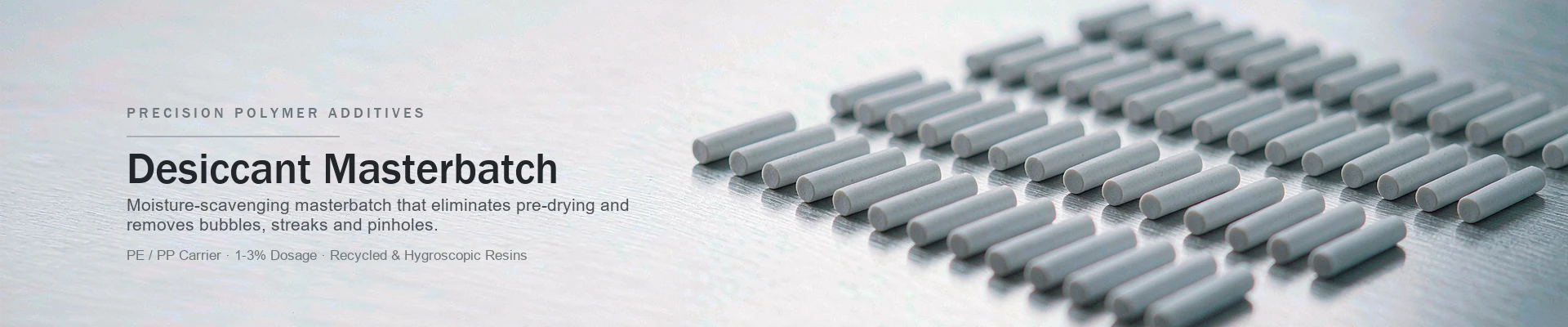

Jiande Xinyu Plastic Materials Co., Ltd. is one of the leading manufacturers and suppliers of desiccant masterbatch for injection molding in China. We have world-leading production equipment and strong manufacturing capabilities. Welcome to wholesale bulk custom made desiccant masterbatch for injection molding from our factory.
PRODUCT AND APPLICATIONS
Product Overview
Desiccant Masterbatch for Injection Molding is a pelletized moisture-control direction for selected polyolefin injection-molding formulas. It is introduced through the normal blending and plasticization route, then evaluated through screw recovery, cavity filling, packing, cooling, surface appearance and the functional properties of the conditioned part.
Silver streaks can be caused by residual water, but they can also result from trapped air, excessive screw decompression, poor venting, contamination, volatile additives or polymer degradation. Internal voids may originate from gas or from insufficient packing and thick-section shrinkage. This product family should therefore be selected through defect evidence rather than appearance alone.
Injection Desiccant Masterbatch is selected for the material and cavity defect that has been identified. A Moisture Control Additive For Molded Products grade must fit the resin family, recycled source, MFR, shot size, screw and barrel condition, residence time, mold venting, part geometry and the properties required after molding.
What the Injection Molder Needs to Separate
Moisture-related splay | Trapped air | Thermal degradation | Packing voids | Mold venting | Surface acceptance | Conditioned-part performance
Select the Grade Direction Around the Molding Defect
Desiccant Masterbatch for Injection Molding covers several grade directions within PE or PP injection molding with diagnosed moisture symptoms. Resin, recycled source, shot utilization, residence time, venting and defect morphology determine the first trial direction.
|
Grade Direction |
Typical Production Focus |
Main Balance to Confirm |
|
Recycled PP injection |
PP molding where manageable water is linked to silver streaks or gas defects. |
Feedstock condition, screw recovery, venting, surface and part strength. |
|
Recycled PE injection |
Selected PE molded products with a defined moisture-related symptom. |
Resin flow, hopper exposure, plasticization, shrinkage and impact. |
|
Surface-defect direction |
Parts where streak direction, gloss and visible gas marks are approval points. |
Dry baseline, decompression, mold venting, residence time and purge evidence. |
|
Thick-wall diagnostic trial |
Parts with internal voids that require separation of gas and shrinkage causes. |
Part section, weight, packing, gate freeze, cooling and water condition. |
Molding Defects This Product Helps the Producer Investigate
Desiccant Masterbatch for Injection Molding is selected around the production result that the customer must control. This product family is relevant when material water contributes to gas during plasticization or filling. Defect position, flow direction and section thickness help distinguish moisture from mold and processing causes.
- Silver streaks or splay: Water, volatile residue, trapped air, excessive decompression or degradation can create streaks following melt flow.
- Internal bubbles: Gas may be trapped during filling, especially around flow fronts, weld lines or poor venting.
- Voids in thick sections: Packing loss and volumetric shrinkage can create internal cavities even when moisture is not the main cause.
- Burn marks: Compressed air at the end of fill, blocked vents, high injection speed or degradation can darken the surface.
- Surface deposits: Volatile contamination, additive migration, degraded polymer or mold-temperature conditions can create repeated marks.
- Part-to-part variation: Recycled-lot changes, poor blending, unstable screw recovery, cushion and cooling alter appearance and dimensions.
Benefits for Injection Molders
Desiccant Masterbatch for Injection Molding supports a defined application and performance range when the grade, formula and line are coordinated. Its value is measured through fewer moisture-related streaks or gas marks while filling, dimensions and mechanical performance remain controlled.
- Molding-specific diagnosis: Connects silver streaks and bubbles with plasticization, decompression, injection speed, venting, packing and cooling.
- Controlled moisture support: Provides a route for managing limited residual water in selected recycled-polyolefin molding formulations.
- Reliable pellet handling: Uniform pellets support consistent blending, conveying and feed into the injection unit.
- Surface-quality review: Keeps splay, flow marks, burn marks, gloss, black specks, deposits and color variation separated in the inspection plan.
- Part-integrity protection: Includes dimensions, warpage, impact, stiffness, weld-line behavior and assembly rather than approving by surface alone.
- Machine-window visibility: Uses screw recovery, cushion, back pressure, melt temperature, transfer, packing and cooling data to explain changes.
- Accepted-part economics: Compares usable part output, cycle time, rejects, regrind and mold cleaning with total formulation cost.
Product Performance Priorities
The practical value of the selected grade is confirmed in conditioned molded parts from each relevant cavity. The priorities below distinguish surface improvement from shrinkage, degradation or mold-related defects.
- Screw recovery: Shows feed and plasticization stability.
- Cushion and part mass: Reveals filling and packing consistency.
- Surface defect map: Links defect type and location with probable cause.
- Internal structure: Distinguishes gas bubble, contamination and shrinkage void.
- Dimensions and warpage: Shows shrinkage and cooling response.
- Mechanical performance: Protects the functional margin of the molded product.
- Assembly and use: Confirms performance beyond isolated specimens.
- Production result: Connects technical response with operating economics.
Applications
Desiccant Masterbatch for Injection Molding is positioned for the application categories below. The supplied grade is selected from polymer family, recycled source, material condition, screw and barrel, mold venting, part geometry and defect type.
- RECYCLED PP INJECTION
- RECYCLED PE INJECTION
- GENERAL HOUSEHOLD MOLDED PRODUCTS
- SILVER-STREAK DIAGNOSIS
- THICK-WALL VOID DIAGNOSIS
FORMULATION AND PROCESSING
How Moisture and Gas Move Through an Injection Formula
Desiccant Masterbatch for Injection Molding is one component in a molding system. Resin, regrind, color, filler and contamination all enter the same screw and must remain compatible with the part and mold.
|
Material Element |
Influence During Molding |
Part-Level Check |
|
Virgin PE or PP |
Defines flow, crystallization, shrinkage, stiffness and impact base. |
Confirm grade, MFR direction and functional duty. |
|
Recycled resin |
Adds moisture, flow, contamination, odor and thermal-history variation. |
Control supplier, lot, washing, pelletizing and blend ratio. |
|
Regrind |
Introduces prior heat history, dust and possible mixed part identity. |
Keep grinding clean and ratio controlled. |
|
Injection desiccant |
Provides limited moisture-control support during plasticization. |
Evaluate dosing, splay, gas, surface and mechanical response. |
|
Filler or color concentrate |
Changes total carrier loading, flow, density, surface and deposits. |
Review combined addition and carrier compatibility. |
|
Release or functional additive |
Influences mold release, static, UV, surface or lubrication. |
Hold the baseline constant when investigating moisture. |
|
Oil, detergent or mixed resin |
Can release volatiles or degrade at the molding temperature. |
Use odor, residue, screen or purge evidence to separate causes. |
This product family selection combines material evidence with the molding record. The same resin can behave differently in a small shot with long residence time and in a large shot using most of the barrel capacity.
Where Moisture-Related Molding Defects Are Controlled
Desiccant Masterbatch for Injection Molding should be evaluated with the machine and mold at production condition. A change in plasticization or venting can reduce or intensify the same visible defect without changing the material formulation.
- Storage, hopper and conveying: Open exposure, damp regrind and long residence in humid air can change material condition before the screw.
- Feed throat: Cooling, bridging, fines and inconsistent bulk density influence feed and screw recovery.
- Screw and barrel: Wear, compression, speed, back pressure and residence time control melting, mixing, air release and thermal history.
- Decompression and nozzle: Excessive suck-back can draw air into the melt; nozzle temperature and restriction influence drool and streaking.
- Injection and transfer: Speed profile and transfer position determine flow-front behavior, gas compression and weld-line formation.
- Packing and cushion: Stable pressure, time and cushion compensate shrinkage until gate freeze and help separate gas bubbles from shrinkage voids.
- Mold vents and parting line: Vent depth, cleanliness and location allow displaced cavity air and volatiles to escape.
- Cooling and ejection: Mold-temperature balance, water flow and ejection timing influence warpage, gloss, sink and final dimensions.
Molding and Moisture Signals to Record
|
Trial Stage |
Evidence to Capture |
Approval Question |
|
Material preparation |
Lot, water condition, blend, exposure and hopper time |
Is the incoming condition understood? |
|
Plasticization |
Recovery, load, back pressure, temperature, decompression and purge |
Is the melt prepared consistently without excess air or heat? |
|
Filling and venting |
Pressure, transfer, cavity pattern, splay and burn location |
Can gas leave the mold and does the defect follow flow? |
Common Injection-Molding Issues and First Checks
Review Desiccant Masterbatch for Injection Molding at the stage where the symptom first becomes measurable. A mapped defect is more useful than a general description. Cavity number, flow direction and the relationship to ribs, gates and end-of-fill locations often identify the next check.
- Splay follows the flow front: Water, volatile contamination, trapped air, excessive decompression or hot residence. Check: Compare material condition, purge appearance, recovery and suck-back.
- Burn mark at end of fill: Blocked vent, high speed, trapped air or degradation. Check: Clean and map vents; compare speed profile and cavity position.
- Void in thick boss: Insufficient packing, early gate freeze, hot core or gas. Check: Section the part and compare mass, cushion, packing and cooling.
TRIAL, TESTING AND GRADE APPROVAL
How to Select and Approve the Injection Desiccant
Evaluation of Desiccant Masterbatch for Injection Molding should use one identified material lot and a stable molding window long enough to compare cavities and conditioned parts. The defect classification should remain unchanged throughout the trial.
Information You Provide
- Provide resin and recycled-source details, measured condition, full formulation, machine size and screw, mold drawing, part duty and photographs showing defect position and flow direction.
- Provide the resin route, hopper exposure, molding record, defect photos or sections, cavity pattern and accepted part reference.
- Define the permitted streaks or voids, dimensions, impact, assembly, cycle and accepted-part yield before evaluation.
What We Assess and Recommend
- We distinguish moisture streaks from trapped gas, burns, shrinkage voids, degradation and mold-venting problems.
- We match the grade direction to resin flow, shot utilization, residence time, mold and part geometry.
- We review cavity-level results and conditioned-part checks before recommending routine use.
What You Confirm on Your Line
- Record a baseline for recovery, cushion, pressure, cycle, part mass, splay, burns, voids, dimensions, warpage and required mechanical or assembly checks.
- Introduce the selected moisture-control material through accurate blending while maintaining a documented temperature, speed, transfer, packing, cooling and vent-cleaning condition.
- Approve after representative cavities and repeated production samples show acceptable surface, internal structure, dimensions and functional performance without creating a new process problem.
Molded-Part Checks
- Screw recovery: Recovery time, back pressure, speed and shot-to-shot variation. Shows feed and plasticization stability.
- Cushion and part mass: Cycle trend by cavity and sampling interval. Reveals filling and packing consistency.
- Surface defect map: Splay, burn, flow mark, black speck and deposit classified separately. Links defect type and location with probable cause.
- Internal structure: Cut section, density comparison or imaging where justified. Distinguishes gas bubble, contamination and shrinkage void.
HOW WE CONTROL PRODUCT QUALITY
We control Desiccant Masterbatch for Injection Molding through incoming inspection, production records, finished-batch release, equipment management and batch traceability. These controls support incoming inspection of the injection desiccant and any later quality follow-up.
- Incoming material inspection: We inspect and release applicable carrier materials, active moisture-control components, processing aids and moisture-protective packaging before use.
- In-process control: We record key controls during material release, weighing, compounding, pelletizing, cooling and sealed packing.
- Finished batch inspection: We release each batch against grade-specific checks for pellet appearance, flow, defined functional indicators and packaging-seal condition, as applicable.
- Production equipment management: We maintain mixing, extrusion, pelletizing, cooling and packing equipment and verify its operating condition.
- Inspection equipment management: We calibrate or verify balances and other functional inspection equipment on controlled schedules.
- Batch identification and traceability: We link each injection desiccant batch with incoming materials, production, inspection, packaging and shipment records.
STORAGE, RESPONSIBLE USE AND FAQ
Handling And Storage
Maintain Dry, Identified Feeding
Keep bags sealed, dry and protected from contamination. Limit open-bag and hopper exposure, reseal partial bags and prevent mixed pellets or dusty regrind from entering the injection unit. Clean conveying and feed equipment during grade changes.
Responsible Use
Molded-Part Approval
Use only after the intended part passes visual, dimensional and functional testing. This product does not correct contamination, degradation or poor mold venting. Automotive, electrical and safety-related parts require separate qualification.
Product FAQ
Q1. What information is needed to evaluate this product family?
Provide resin and recycled source, water result and sample point, full formulation, machine and screw, recovery settings, mold and vent layout, part geometry, defect map and required functional tests.
Q2. What should an Injection Desiccant Masterbatch trial prove?
It should reduce the confirmed moisture-related contribution while maintaining stable plasticization, cavity filling, surface, dimensions, mechanics and assembly.
Q3. Is Moisture Control Additive For Molded Products a substitute for drying?
It provides limited process support for selected polyolefin applications. Proper material conditioning remains necessary when feedstock moisture exceeds the practical molding window.
Q4. Are all silver streaks caused by moisture?
No. Air intake, poor venting, volatile contamination, excessive residence and degradation can create similar marks. Defect position and machine data help distinguish them.
Q5. How can a gas bubble be separated from a shrinkage void?
Review its location and shape together with part mass, packing, cushion, gate freeze, cooling and a controlled cut section or imaging result.
Q6. Why should each cavity be inspected separately?
A defect limited to one cavity often points to its gate, vent, cooling or geometry rather than a uniform material condition.
Q7. Can it be used with recycled PP or PE?
Selected general molded products can be evaluated when material identity, contamination, moisture, flow and finished-part requirements are controlled.
Q8. What does Moisture Control Additive For Molded Products not solve?
It does not remove black contamination, restore degraded polymer, correct a blocked mold vent or replace the packing and cooling needed for thick sections.
Discuss Your Molding Defect and Part Requirement
Share the PP or PE grade, recycled source, material condition, machine, mold, cycle, defect pattern and part tests. We will assess whether an injection desiccant trial addresses the identified cause.
Hot Tags: desiccant masterbatch for injection molding, China desiccant masterbatch for injection molding manufacturers, suppliers, factory