

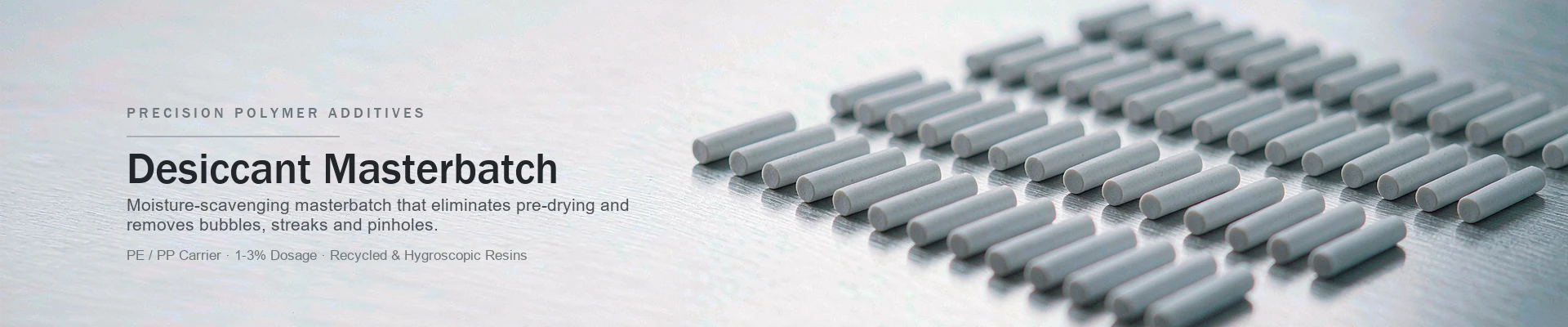

Jiande Xinyu Plastic Materials Co., Ltd. is one of the leading manufacturers and suppliers of desiccant masterbatch for blow molding in China. We have world-leading production equipment and strong manufacturing capabilities. Welcome to wholesale bulk custom made desiccant masterbatch for blow molding from our factory.
PRODUCT AND APPLICATIONS
Product Overview
Desiccant Masterbatch for Blow Molding is developed as a moisture-control direction for extrusion blow molding of selected hollow products. The grade must work within the melt-strength requirement of the resin and the actual machine sequence: plasticization, head filling, parison extrusion, mold closing, blowing, cooling, trimming and final leakage or mechanical checks.
Moisture-related gas can create bubbles, fine voids, roughness or weak sections, yet the same symptoms can originate from parison stretch, trapped air, contamination, resin degradation, poor venting or material trapped at the head. This product family therefore belongs in a container-level evaluation, not a surface-only comparison.
Moisture Control Masterbatch for a hollow product must be selected around extrusion blow molding rather than film production. A Film Blowing Desiccant Masterbatch and a Defoaming Masterbatch For PP may serve different processes; polymer, parison rheology, head and die design, wall map and final container duty determine the correct direction.
What the Blow Molder Needs to Protect
Stable parison | Head and die cleanliness | Controlled wall distribution | Sound pinch-off and neck | Leak resistance | Drop and top-load performance | Repeatable cycle
Select the Grade Direction Around the Hollow-Product Defect
Desiccant Masterbatch for Blow Molding covers several grade directions within extrusion blow molding with diagnosed moisture-related gas. Polymer, parison rheology, head residence, wall map and defect location determine the relevant moisture-control direction.
|
Grade Direction |
Typical Production Focus |
Main Balance to Confirm |
|
General recycled blow molding |
Selected recycled PE hollow products with diagnosed water-related defects. |
Material condition, parison stability, surface, wall map and rejects. |
|
Large industrial hollow products |
Drums and jerry cans where long parison time increases process sensitivity. |
Melt strength, head residence, sag, wall program, leak and drop. |
|
Pinch-off and surface focus |
Parts where bubbles, pinholes or seam quality drive approval. |
Defect cross-section, die condition, contamination, water and mold venting. |
|
Selected PP blow-molding trial |
Defined PP hollow-product programs after resin and equipment review. |
PP rheology, parison control, cooling, deformation and functional tests. |
Blow-Molded Defects This Product Helps the Producer Investigate
Desiccant Masterbatch for Blow Molding is selected around the production result that the customer must control. This product family addresses a specific part of the defect picture: manageable moisture-related gas. The container geometry and the process stage where the defect forms indicate which other causes must be checked.
- Bubbles in the wall: Residual water, volatile contamination, trapped air or material degradation can create enclosed gas pockets.
- Pinholes at stretched zones: Low local thickness, contamination, gas pockets and excessive parison stretch can open during blowing.
- Weak pinch-off: Melt temperature, parison thickness, mold lands, contamination and cooling determine weld integrity at the bottom seam.
- Uneven wall distribution: Parison sag, die swell, programming, mold geometry and inflation timing determine where material moves.
- Neck or closure leakage: Finish dimensions, flash, cooling, trimming and local gas defects can interfere with cap or seal performance.
- Cycle instability: Feed variation, head residence, temperature drift, cooling imbalance and regrind condition change container weight and ejection.
Benefits for Blow-Molding Processors
Desiccant Masterbatch for Blow Molding supports a defined application and performance range when the grade, formula and line are coordinated. Its value is measured through cleaner parison formation and fewer gas defects while wall, leak and mechanical performance remain acceptable.
- Hollow-product focus: Evaluates moisture control through parison formation, inflation, pinch-off, cooling and trimming rather than by pellet appearance alone.
- Weak-point identification: Directs inspection to handles, corners, necks, weld or pinch lines and programmed thin sections where gas-related defects matter most.
- Compatible pellet delivery: Supports clean blending and stable feeding with selected PE or PP blow-molding formulations.
- Recycled-resin diagnosis: Includes moisture, contamination, mixed resin, MFR or HLMI variation, odor and previous heat history in the selection discussion.
- Container-integrity review: Keeps wall-thickness distribution, leak, drop, top-load, closure fit and application-specific compatibility in the approval plan.
- Process-window visibility: Connects the formula with screw recovery, head residence, die gap, parison programming, blow pressure and mold cooling.
- Production-value measurement: Reviews accepted container output, trimming loss, leakage, cycle stability and scrap together with formulation economics.
Product Performance Priorities
The practical value of the selected grade is confirmed in cooled hollow products from a controlled moisture comparison. The priorities below separate a useful gas-defect reduction from changes in wall distribution or pinch-off quality.
- Container mass: Shows shot consistency and material distribution changes.
- Wall-thickness map: Identifies thin zones and parison-program effects.
- Visual and cross-section: Separates surface appearance from internal gas pockets.
- Leak integrity: Confirms wall, neck and pinch-off sealing.
- Drop performance: Challenges impact, corners, handle and weld integrity.
- Top load or compression: Shows stacking and structural response where relevant.
- Dimensions and capacity: Protects cap fit, filling and downstream handling.
- Cycle and reject rate: Connects moisture control with production value.
Applications
Desiccant Masterbatch for Blow Molding is positioned for the application categories below. The supplied grade is selected from resin and recycled ratio, water condition, head and die, parison behavior, mold and hollow-product duty.
- RECYCLED BLOW-MOLDED CONTAINERS
- INDUSTRIAL HOLLOW PRODUCTS
- JERRY CANS AND DRUMS
- RECYCLED PE BLOW MOLDING
- NON-PRESSURE NON-FOOD-CONTACT PRODUCTS
FORMULATION AND PROCESSING
How the Blow-Molding Formula Builds a Hollow Product
Desiccant Masterbatch for Blow Molding enters a formula that must retain enough melt strength to form and hold a parison. Every component can affect sag, swell, welding at the pinch-off and the final wall profile.
|
Formula Element |
Influence on the Parison |
Container-Level Check |
|
Blow-molding PE or PP |
Defines melt strength, swell, crystallization and cooling response. |
Confirm grade, flow direction and intended container duty. |
|
Recycled resin |
Adds variability in moisture, flow, contamination, color and odor. |
Control source, lot, blend ratio and filtration history. |
|
Regrind and trim return |
Changes heat history, bulk density and contamination exposure. |
Maintain identity, particle size and a controlled return ratio. |
|
Blow-molding desiccant |
Provides limited moisture-control support during plasticization. |
Check dispersion, gas defects, parison response and container integrity. |
|
Color or filler masterbatch |
Changes total concentrate loading, density, stiffness and melt response. |
Review carrier compatibility and combined effect on pinch-off and impact. |
|
Stabilizer or processing aid |
Influences thermal stability, die condition, release and surface. |
Hold the baseline formulation stable during evaluation. |
|
Post-consumer residues |
Detergent, oil, label, ink or incompatible resin may release gas or create weak points. |
Inspect odor, screen residue and fracture or leak location. |
Selection of this product family requires the resin, machine, mold and end-use specification. A defect at the body wall, neck, handle or pinch-off does not carry the same risk and should not receive the same test plan.
Where Hollow-Product Quality Is Controlled
Desiccant Masterbatch for Blow Molding should be assessed on the intended continuous-extrusion or accumulator-head machine. Machine history, head design and mold cooling strongly influence whether a moisture-control effect becomes a reliable container improvement.
- Hopper and feed system: Pellet segregation, bridging, open exposure and inconsistent regrind bulk density can change each shot or cycle.
- Extruder and screw: Feed stability, screw wear, temperature, speed, motor load and residence time control melting and gas evolution.
- Venting where fitted: An open and stable vent removes gas; vent flooding, weak vacuum or melt blockage reduces removal efficiency.
- Accumulator or continuous head: Residence time, flow paths, stagnant zones and pressure stability influence degradation and shot consistency.
- Die and parison programmer: Die gap, mandrel condition and programmed profile distribute material to corners, handle and base.
- Mold closing and blowing: Closing speed, pinch lands, pre-blow, blow pressure and timing determine weld and shape formation.
- Cooling and exhaust: Water-flow balance, mold temperature and air exhaust control cycle, dimensions and trapped-air marks.
- Trimming and leak test: Deflashing, neck finishing and online leak detection reveal functional defects before packing.
Parison and Moisture Signals to Record
|
Evaluation Point |
Evidence to Record |
Decision |
|
Feed and plasticization |
Lot, water condition, load, temperature, vent and pressure |
Is the melt preparation stable and repeatable? |
|
Parison |
Length, sag, swell, surface, program and cycle consistency |
Can the intermediate tube be controlled? |
|
Molded container |
Mass, wall map, bubbles, pinch-off, neck and dimensions |
Is material distributed without critical defects? |
Common Blow-Molding Issues and First Checks
Review Desiccant Masterbatch for Blow Molding at the stage where the symptom first becomes measurable. The defect location provides a fast diagnostic path. Repeated defects at one mold feature usually require a geometry or process check in addition to material review.
- Bubbles throughout the wall: Residual water, volatile contamination, degradation or trapped gas. Check: Compare material lot, odor, water result, vent and melt temperature.
- Pinholes only at corners: Thin wall, excessive stretch, parison program, contamination or gas pocket. Check: Map wall thickness and adjust parison distribution before changing multiple factors.
- Bottom seam leakage: Weak pinch-off, hot parison, contamination, damaged lands or poor cooling. Check: Inspect cut seam, mold lands, wall thickness and leak position.
TRIAL, TESTING AND GRADE APPROVAL
How to Select and Approve the Blow-Molding Desiccant
Evaluation of Desiccant Masterbatch for Blow Molding should follow the container from resin bag to leak tester. A stable parison and a passing finished product are both required before the material is considered suitable.
Information You Provide
- Provide resin and recycle details, material conditioning, machine and head configuration, mold and parison program, container drawing, service duty and current defect map.
- Provide the resin route, material condition, head settings, parison record, defect cross-section, wall map and accepted hollow product.
- Define the permitted gas defects, minimum wall, leak, drop, dimensions and accepted-part yield for the intended product.
What We Assess and Recommend
- We distinguish moisture-related gas from trapped air, degradation, contamination, head condition and pinch-off defects.
- We match the grade direction to resin, parison rheology, head design, wall map and defect location.
- We review repeated hollow-product checks before recommending routine use.
What You Confirm on Your Line
- Build a baseline for head pressure, parison length and sag, cycle time, container mass, wall map, bubbles, leaks, pinch-off and mechanical results.
- Run the selected moisture-control grade with accurate dosing and stable process settings, recording changes through plasticization, parison formation, blowing and cooling.
- Approve after representative containers pass visual, wall, leak, dimension and application-specific mechanical checks over a stable production period.
Hollow-Product Checks
- Container mass: Cycle-by-cycle weight and flash or trim weight. Shows shot consistency and material distribution changes.
- Wall-thickness map: Ultrasonic, mechanical or cut-section measurement at defined points. Identifies thin zones and parison-program effects.
- Visual and cross-section: Bubbles, voids, streaks, roughness and pinch-line inspection. Separates surface appearance from internal gas pockets.
- Leak integrity: Online leak test and application-specific closure check. Confirms wall, neck and pinch-off sealing.
HOW WE CONTROL PRODUCT QUALITY
We control Desiccant Masterbatch for Blow Molding through incoming inspection, production records, finished-batch release, equipment management and batch traceability. These controls support incoming inspection of the blow-molding desiccant and any later quality follow-up.
- Incoming material inspection: We inspect and release applicable carrier materials, active moisture-control components, processing aids and moisture-protective packaging before use.
- In-process control: We record key controls during material release, weighing, compounding, pelletizing, cooling and sealed packing.
- Finished batch inspection: We release each batch against grade-specific checks for pellet condition, flow, defined functional indicators and packaging integrity, as applicable.
- Production equipment management: We maintain mixing, compounding, pelletizing, cooling and packing equipment and verify its operating condition.
- Inspection equipment management: We calibrate or verify balances and other functional inspection devices on controlled schedules.
- Batch identification and traceability: We link each blow-molding desiccant batch with incoming materials, production, inspection, packaging and shipment records.
STORAGE, RESPONSIBLE USE AND FAQ
Handling And Storage
Protect the Material Before It Reaches the Head
Store bags sealed, dry and clearly identified. Minimize open-bag exposure, prevent pellet contamination, and avoid leaving material in humid hoppers for extended periods. Clean feed and conveying equipment during grade changes and maintain recycled and regrind lots separately.
Responsible Use
Hollow-Product Approval
Use only after the intended container passes wall, leak and mechanical testing. This product does not replace drying or raw-material control. Food-contact, chemical, pressure-related and drop-critical containers require separate qualification.
Product FAQ
Q1. What information is needed to evaluate this product family?
Provide polymer grade, recycled and regrind ratios, material conditioning, machine and head type, mold and parison program, container drawing, defect location, leak or drop results and end-use duty.
Q2. What should Moisture Control Masterbatch prove in blow molding?
It should reduce the moisture-related contribution while maintaining stable parison formation, wall distribution, pinch-off, neck dimensions, leakage resistance and required mechanical performance.
Q3. Is Film Blowing Desiccant Masterbatch the same product for hollow containers?
No. Blown film and extrusion blow molding use different dies, melt-strength demands and finished-product tests. The grade must be selected for the actual process.
Q4. Can Defoaming Masterbatch For PP stop every bubble?
No. Gas can come from water, volatiles, trapped air, contamination or degradation. A Defoaming Masterbatch For PP trial is relevant only after the polymer, material history and defect cause are reviewed.
Q5. Why is the parison checked before the container?
Parison length, sag, swell, surface and programmed thickness explain how material reaches the neck, handle, corner and pinch-off.
Q6. Which finished-product tests are most important?
Wall-thickness mapping, leak testing, dimensions, closure fit and duty-specific drop or compression checks provide a practical container-level decision.
Q7. Can it be used with recycled PE?
Selected recycled PE blow-molding applications can be evaluated when source, washing, water condition, contamination, filtration and mechanical requirements are controlled.
Q8. Why is a pressure or chemical container reviewed separately?
Service pressure, permeation, chemical compatibility, closure integrity and regulatory obligations require evidence beyond a general moisture-control trial.
Discuss Your Parison Defect and Hollow Product
Share the resin, recycled ratio, material condition, head and die, parison behavior, defect location, wall map and functional tests. We will assess the relevant blow-molding moisture-control direction.
Hot Tags: desiccant masterbatch for blow molding, China desiccant masterbatch for blow molding manufacturers, suppliers, factory